
Explore the unique aspects of bookstore design in an interview with Neoluxe Studio’s director featured in Ural Trade Equipment magazine.
Natalia Zinkovich (From an interview with the magazine Trade Equipment in the Urals) Modern book business owners typically focus on the use of advanced technologies, maximum automation of their business, and collaboration with professionals from the outset. Without this, it is difficult to run a business in our age of high technology, let alone expect its successful development. This is the opinion of our experts – specialists from the design studio NEOLUXE.
Ergonomics of a Bookstore
The design and organization of a bookstore’s space have serious requirements, – says the director of the NEOLUXE design studio, Vladimir Anatolyevich Kandalov. – The first of these is safety: it is important that the entire room can be viewed from any point in the hall. On one hand, this is related to navigation – the movement of visitor flows: it is essential that customers can easily navigate the space and find the book they need or reach the department of interest without hindrance. On the other hand, it relates to the equally important aspect of theft prevention in the book trade.
One of the methods for addressing such issues in bookstores (and beyond) is the installation and use of mirrored hemispheres and video cameras. The next important requirement is proper zoning and convenient navigation. It is necessary to consider that the products in a bookstore are heterogeneous, and the assortment is diverse, so it is essential to distinguish between the main and secondary items.
The main items are usually the hits and new releases. They are highlighted in a separate area, which is most often located in front of the checkout area or at the entrance. It is necessary for the books that are considered most important for sale to attract the customer’s attention upon entering the sales floor and to encourage spontaneous purchases as they exit the store. Based on these tasks, the types of trade equipment, stylistic, and structural solutions are determined.
Most often, tall shelves and stands are arranged around the perimeter of the sales area, while the hall itself uses shelves designed with human anthropometric parameters in mind, allowing for an open view. Special tables and podiums are used to showcase new releases. In general, it is best to use a modular principle. This way, a comfortable space is achieved through the arrangement of a series of standardized components. It is necessary to have a sufficient number of book copies directly in the hall, so the store’s trade equipment can also be used for storing books right in the sales area. For this purpose, cabinets with doors or special pedestals are suitable, the tops of which can be adapted for displaying books, while the inside has a niche for storing a certain quantity of goods. A factor that ensures the successful uninterrupted operation of the store is good navigation.
The movement of visitor flows must be clearly coordinated: people should not cross paths, disturb each other, experience any discomfort when selecting products, or create such discomfort. Often, with poorly thought-out ergonomics in a bookstore, customers cannot even move apart, let alone browse (and especially flip through) the book they need. This seriously affects the store’s foot traffic and the financial health of the business. – Usually, a person moves clockwise, – adds the deputy director of the NEOLUXE design studio, Olga Alexandrovna Zavada. – The space of the sales hall should be organized so that the customer can walk around the entire exhibition without encountering those who are still choosing or have already chosen books, and can freely proceed to the checkout to pay for their selected items. – To help customers easily navigate, effective visual communication systems are implemented: clear signs and indicators, distinct department names, large readable fonts, striking, bright, or contrasting color combinations, etc., – continues V. A. Kandalov. – Modern electronic navigation tools, electronic catalogs, and systems for finding necessary books, magazines, and various digital media are also introduced.
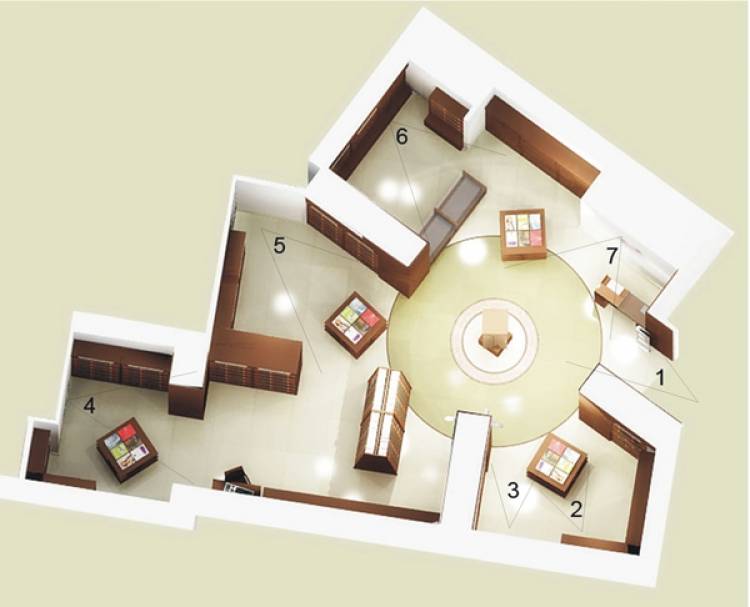
Example of a bookstore project
For product viewing, modern interactive technologies such as JESTPOINT and GROUND FX may be used. Wireless data transmission technologies like BLUETOOTH can be employed for advertising new or popular printed products. A bookstore is a place where a customer has to concentrate their attention for a considerable amount of time on closely examining books and reading text, i.e., straining their eyesight and experiencing a significant load on their eyes. Therefore, special requirements for lighting are imposed here. First, it should not distort color reproduction. Second, it should be uniform and bright enough, but not blinding. There are certain European lighting standards for bookstores that must be met – about 700 lux at the working plane (that is, at the level where a person will be viewing a book) and no less than 300 lux in other areas. Unfortunately, in Russian stores, these figures are often three times lower. Attention must also be paid to the flooring. If it is ordinary porcelain stoneware, paths will form along the main visitor flows as the top layer wears out quickly.
Given the high foot traffic of these retail establishments, special flooring made of wear-resistant materials should be chosen. There are now very reliable technologies, such as quite durable poured floors and heterogeneous floor coverings – commercial linoleum, which also has dust-repellent properties. In general, the issue of dust control in bookstores is one of the most important, so the flooring should be easy to clean during wet cleaning. Accordingly, certain requirements are also imposed on trade equipment and its placement: it must comply with sanitary and hygienic standards and be made from materials that withstand cleaning well. Additionally, there should be no hard-to-reach places for cleaning, so that dust does not accumulate there. For these same purposes, a reliable air conditioning system should be installed in the store.
The Problem of Theft and Vandalism in a Bookstore
The key to the safety of any bookstore is the choice of reliable equipment to protect goods from theft and vandalism. A distinctive feature of bookstores is the use of closely arranged shelves that hold a large number of relatively small items. – Trade equipment must be vandal-resistant, have a reliable, sturdy construction, and at the same time not cause discomfort to the customer either physically (in case of falling, destruction, etc.) or morally-ethically. That is, a person should not feel suspicious. Maintaining this golden mean requires special delicacy in the placement and use of equipment designed to protect books, – notes our expert.
For effective protection against theft of printed publications, it is recommended to use a complex of equipment consisting of anti-theft systems, sensors, deactivators, and security mirrors. Overview and dome security mirrors, as well as video cameras, serve as effective and inexpensive means to increase visibility in the sales hall. Their use will allow bookstore staff to monitor order in the sales hall more effectively, prevent attempts to steal and damage books. Overview mirrors are equipped with flexible brackets and have an increased height of curvature. Cameras are also directed at these hemispheres, allowing security to read panoramic information from them. Radio frequency and electromagnetic systems provide effective protection. The difference lies in their cost, the ability to work in aisles of various widths, and – most importantly – the size of protective sensors. Radio frequency systems mainly use a flexible protective sensor measuring 40 x 40 mm, which can be white or have a barcode imitation.
Such a sensor, when applied correctly, will optimally protect any publications. Electromagnetic systems use flexible “invisible” sensors that are very small, allowing them to be placed in the spines of books, which practically eliminates the possibility of theft. When choosing a truly reliable protection system for a bookstore, it is recommended to pay attention to the following nuances: * the anti-theft system must reliably detect the sensor in various projections; * protective sensors must adhere securely to the product and be unobtrusive; * it is preferable for the anti-theft system to have operational indication; * the use of convex acousto-magnetic sensors is not permitted.
In any case, the choice of anti-theft equipment is very individual and depends on many factors, so it is better to consult professionals. Prospects for the Development of the Russian Book Trade Market It is expected that in the future the Russian market will follow the Western path. Abroad, large universal bookstores have free access to books, and for the convenience of visitors, there are opportunities to stay in the store for hours: there are special reading and relaxation areas, and some stores have cafes, non-alcoholic bars, and even restaurants. Stores are equipped with high-tech systems, furnished with the most modern book trade equipment, soft sofas, and coffee tables.
Professional consultants from a computer-equipped information desk…